


Eyewear size guide and standards
- SIZE GUIDE: FRAMES / GOGGLES
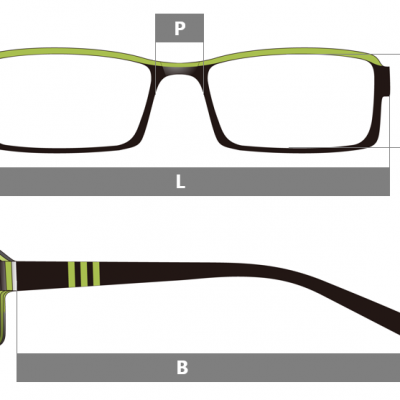
| Code | Description |
|---|---|
| L | Frame width |
| P | Bridge size / nose |
| H | Lens height |
| B | Temple length |
The reference unit of measurement is mm.
- EUROPEAN STANDARDS: EYE PROTECTION
Safety equipment must comply with specific European standards. Regarding glasses and goggles, both frames and lenses must meet these standards and are marked with identifiable symbols. These markings must be present on all optical protective equipment, whether corrective or not.
FRAME MARKINGS AND STANDARDS

CE : Conformity symbol with PPE Directive 89/686/EEC and Regulation 2016/425.
EN166 : General standard for protective eyewear, guaranteeing resistance to common hazards. The standard defines construction and performance specifications, namely optical properties such as power, light transmission and diffusion factors, as well as mechanical properties such as robustness, thermal stability and impact resistance.
LENS MARKINGS AND STANDARDS

The different optical classes:
- Optical class 1 provides perfect optical quality for continuous wear.
- Optical class 2 is suitable for intermittent wear.
- Optical class 3 is only suitable for brief and occasional tasks.
The different resistance symbols:
| Mechanical resistance | |
| S | Increased robustness, resists a 22mm ball weighing 0.43g dropped from 1.30m at 5.1m/s. |
| F | Low energy impact, resists a 6mm ball weighing 0.86g at 45m/s. |
| B | Medium energy impact, resists a 6mm ball weighing 0.86g at 120m/s. |
| A | High energy impact, resists a 6mm ball weighing 0.86g at 190m/s. |
| T | Immediately following the mechanical resistance symbol, the letter T indicates suitability for exposure to high-speed particles at extreme temperatures (-5°C/+55°C). |
| K | Resistance to surface damage caused by fine particles |
| N | Resistance to fogging |
| 8 | Resistance to electric arc and short circuit |
| 9 | Resistance to molten metal and hot solids |
Filter type symbols:
| Symbol | Filter type |
| 2 | UV filter |
| 2C | UV filter with good colour perception |
| 4 | Infrared filter |
| 5 | Solar filter for industrial use |
| 6 | Solar filter with infrared specification |
Tint type symbols:
| Tint | Description |
| 1.2 | Clear, Yellow, Amber, Vision+ |
| 1.4 | Blue Blocker lenses (orange and brown) |
| 1.4 < 2 | Photochromic lens tinted from 1.4 to 2 |
| 1.7 | Indoor Outdoor, Blue Blocker lens |
| 2 | Orange 550nm |
| 2.5 | Smoke or brown |
| 3.1 | Smoke, polarised or mirrored (red, silver) |