


Eye and Vision
- THE MAIN VISION DEFECTS
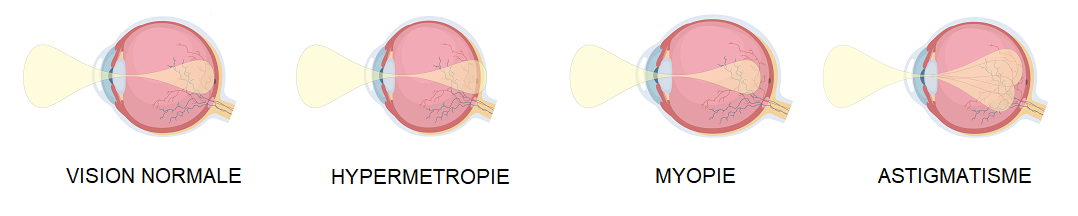
Short-sightedness (myopia)
As the eye is longer than normal, the image of a distant object seen by a short-sighted eye is blurred because the image forms in front of the retina.
Short-sightedness is corrected using a divergent lens.
Short-sightedness is becoming increasingly common for reasons linked to lifestyle and environment (prolonged close-up work).
Long-sightedness (hyperopia)
As the eye is shorter than normal, the image of an object seen by a long-sighted eye is blurred because the image forms behind the retina.
Long-sightedness is corrected using a convergent lens.
Astigmatism
The shape of the cornea is more oval than round. As a result, the image does not form on the retina but either in front of or behind it, causing it to appear distorted.
Astigmatism is corrected using a toric lens. It is often combined with another vision defect such as short-sightedness, long-sightedness or presbyopia.
Presbyopia
Presbyopia is independent of short-sightedness, long-sightedness or astigmatism; it is related to age and typically appears from around 40 years old.
With age, the lens of the eye loses some of its elasticity and ability to focus. As the eye can no longer produce a sharp image, those affected find it increasingly difficult to see up close. They will initially hold reading material further away to bring it into focus, then seeing fine details and small print will become impossible without suitable correction.
Presbyopia is generally corrected using progressive or multifocal lenses, although it is also possible to correct close-up vision alone using a single-vision lens.